Squeeze Together, Game Together: The Glorious Return of the Shared Screen
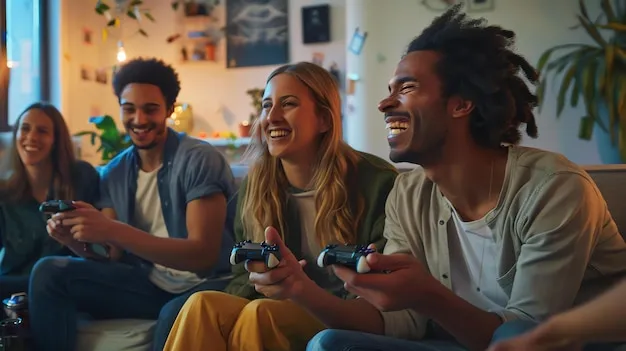
Photo: friends laughing playing video games together on couch living room controllers, via img.freepik.com
Picture this: four people crammed onto a couch that was really designed for two. Someone's controller cord is doing something geometrically impossible. There's a half-eaten bag of Doritos creating a territorial boundary dispute between players two and three. Somebody just accidentally paused the game with their knee. Everyone is screaming.
This is not a problem. This is the whole point.
Local multiplayer — the art of sharing a screen, a couch, and frankly way too much personal space with other humans — was supposed to be dead. Online gaming killed it, or so the industry confidently declared sometime around 2010 when split-screen started quietly disappearing from AAA titles like an embarrassed relative at a family reunion. And yet here we are, in the mid-2020s, watching couch co-op stage the kind of comeback that makes you want to stand up and applaud.
How Online Gaming Accidentally Made Us Lonely
The promise of online multiplayer was enormous and, to be fair, largely delivered. You could play with anyone, anywhere, anytime. Your childhood friend who moved to Portland? Still on your team. A random stranger in Finland who is inexplicably better at this game than you'll ever be? Your new teammate. The world shrank, and gaming got genuinely global.
But something got lost in the translation. When everyone started gaming in separate rooms — separate apartments, separate cities — the shared physical experience quietly evaporated. You could hear your friends through a headset but you couldn't see them wince when they got eliminated. You couldn't watch someone's face cycle through all five stages of grief after a bad round. The communal chaos, the texture of playing games together in the same room, got replaced by a clean, lag-compensated, socially distanced version of togetherness.
For a generation that increasingly finds itself staring at screens in isolation, that trade-off started to feel less like progress and more like something quietly sad.
Gen Z Didn't Grow Up With Split-Screen. They Want It Anyway.
Here's the twist that nobody in the industry saw coming: younger players who barely experienced the golden age of couch co-op are actively seeking it out. Gen Z, raised on online gaming and Discord servers, has developed a genuine appetite for gaming experiences that require physical presence. Not because of nostalgia — they don't have nostalgia for it — but because it scratches an itch that online play simply cannot reach.
There's a reason "couch co-op" has become a legitimate search term on platforms like TikTok and Reddit, with users hunting for recommendations with almost archaeological enthusiasm. Games like It Takes Two, Overcooked, and Cuphead didn't just sell well — they became events. Things people filmed themselves playing. Reactions worth sharing. The chaos and the failure and the screaming at each other became the content.
Online gaming produces highlights. Local co-op produces memories.
The Indie Scene Noticed First
While major studios were busy quietly removing split-screen to save on development costs and server headaches, indie developers were paying attention to what people actually missed. The result has been a quiet explosion of local multiplayer titles that punch so far above their weight class it's almost unfair.
Lovers in a Dangerous Spacetime — two players, one ship, pure cooperative chaos. TowerFall Ascension — a local archery brawler so well-designed it makes $60 games look lazy. Moving Out — a physics-based furniture-hauling game that turns your friendship into a structural engineering disaster. Nidhogg — two players, one screen, fencing that somehow turns into the most intense experience you can have on a couch.
None of these games had nine-figure budgets. None of them needed one. What they understood — what their developers understood — is that local multiplayer has a fundamentally different design philosophy than online gaming. The screen has to be readable for multiple people at once. The controls have to be learnable in thirty seconds because you're not going to make your friend read a tutorial. The failure states have to be funny, not frustrating, because the person you just failed alongside is sitting right there watching your face.
These aren't compromises. They're design constraints that produce better, more human games.
No Discord Required (That's a Feature, Not a Bug)
There's a growing micro-movement in gaming spaces around what you might call "frictionless IRL play" — the idea that the best multiplayer experiences are the ones that require the least setup and the most presence. No account linking. No server browsers. No voice chat software to configure. You hand someone a controller and you start playing.
This sounds simple because it is simple, and that simplicity is becoming a genuine selling point in a gaming landscape that has gotten extraordinarily complicated. When you can spend twenty minutes troubleshooting why your friend can't join your lobby before giving up and watching TV instead, the appeal of "plug in, scoot over, press start" becomes almost spiritual.
Game nights are making a comeback in American households in a way that feels genuinely meaningful. Board games had their renaissance. Tabletop RPGs got trendy. And now couch co-op is completing the hat trick — offering something that streaming services and online lobbies can't quite replicate: an excuse to be in the same room as people you like, doing something together.
Where to Start If Your Couch Is Ready
If you want to dive into the local multiplayer revival without spending a fortune, the options are genuinely excellent right now. The Nintendo Switch was practically built for this moment — detachable controllers, portable screen, a library stuffed with couch-friendly titles. But don't sleep on PC and PlayStation either, where indie storefronts have made local co-op gems cheaper and easier to find than ever.
Start with something forgiving and funny before you graduate to something that will test your relationships. Overcooked is chaos with training wheels. It Takes Two is a masterclass in cooperative design. And if you really want to see what your friendships are made of, Gang Beasts will provide a definitive answer in approximately eight minutes.
The couch is waiting. The controllers need charging. Someone's going to have to be the one to bring snacks.
This is local multiplayer. It's always been this good. We just forgot for a while.