Long Live the Weird Web: How Bizarre Browser Games Became the Underground's Favorite Rabbit Hole
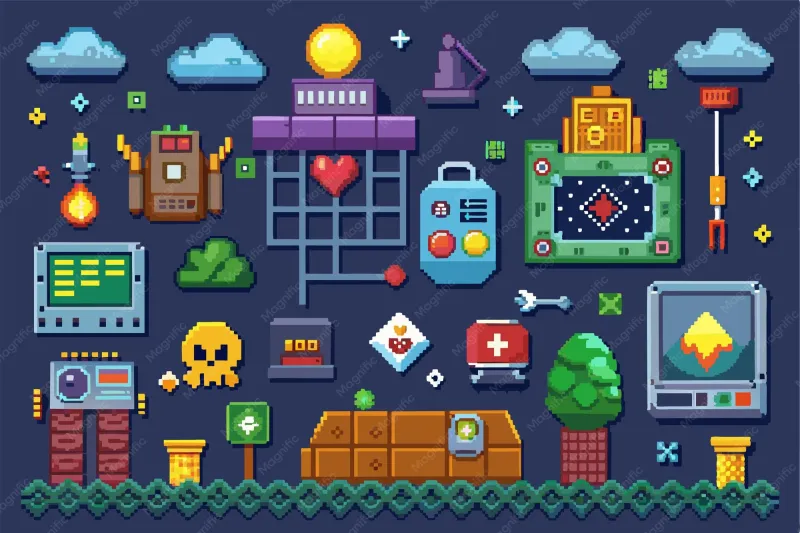
Photo: retro pixel art computer screen colorful abstract game, via img.freepik.com
Somewhere between a AAA open-world epic and a mobile game that begs you for your credit card every forty-five seconds, there exists a different kind of digital experience. It lives in browser tabs. It has graphics that look like they were rendered on a potato. Its sound design is either completely absent or deeply unsettling. Its instructions, if it has any, raise more questions than they answer.
And right now, people cannot get enough of it.
Browser-based weird games — the strange, lo-fi, experimental, occasionally unclassifiable kind — are having a genuine moment. Not a comeback, exactly, because they never really went away. More like a cultural reappraisal. The kind where something that was always quietly there suddenly gets recognized for the art form it actually is.
The Myth of Flash's Funeral
Let's address the elephant in the room, or rather, the Adobe plugin in the browser. When Flash officially died at the end of 2020, a lot of people wrote the obituary for browser gaming as a whole. Entire childhoods of Newgrounds memories, early-internet weirdness, and deeply questionable flash animations seemed to dissolve overnight.
Except they didn't.
Developers, archivists, and devoted fans had already been preparing. Projects like Flashpoint have preserved tens of thousands of Flash games and animations, making them accessible through a dedicated launcher. The Internet Archive stepped up too, running Flash emulation directly in the browser for a massive catalog of classic content. For the truly nostalgic, the old stuff is more accessible now than it was in 2018.
But the more interesting story isn't preservation — it's what grew in Flash's absence. HTML5, WebGL, and platforms like itch.io created fertile ground for a new generation of browser-based creators who weren't trying to recreate the past. They were building something stranger.
The itch.io Dimension
If you haven't explored itch.io lately, buckle up. The platform has become the de facto home of experimental browser gaming, and its catalog reads like someone asked an AI to describe games using only fever dream imagery.
There are games that last thirty seconds and somehow leave you thinking about them for three days. Games with no win condition, no lose condition, and no discernible objective beyond existing in a particular digital space for a while. Games that appear to be about one thing and reveal themselves to be about something else entirely — grief, insomnia, the specific feeling of being in a Walmart at 2 a.m.
The platform's "pay what you want" model, including free, means the barrier to both creating and playing is essentially zero. This has produced an astonishing volume of work, most of it weird, some of it brilliant, and occasionally both simultaneously.
Jameson Reed, an indie developer based in Chicago who makes browser games under the handle "NullRooster," describes itch.io as "the last genuinely democratic space in gaming." His most-played game involves navigating a bureaucratic office that subtly shifts its layout every time you look away. It has no explanation. It has thousands of plays. "I made it in a weekend," he told us. "I still don't entirely know what it's about."
Why Gen Z and Millennials Are Specifically Here for This
The demographics of the weird browser game revival are interesting. While older millennials have nostalgia pulling them toward classic browser experiences, younger millennials and Gen Z players seem drawn by something different: exhaustion.
Exhaustion with the scale and obligation of modern AAA gaming. Exhaustion with games that require a forty-hour investment before they get interesting. Exhaustion with games that are essentially second jobs, complete with daily login bonuses and battle pass anxiety.
A browser game that takes eight minutes and makes you feel genuinely weird? That's a palate cleanser. That's a micro-vacation.
There's also a strong anti-polish aesthetic at work here, which tracks with broader Gen Z cultural tastes. In music, in video, in visual art, intentionally rough, lo-fi, and "unfinished" aesthetics have become a genuine style choice rather than a limitation. The same logic applies to games. Pixelated graphics, janky physics, and placeholder sound effects aren't bugs — they're a vibe. They signal authenticity, creative risk, and a rejection of the corporate smoothness that defines mainstream releases.
Sophia Ng, a game design student in Seattle who streams browser games on Twitch under the name "TabCrawler," puts it simply: "When a game looks like it was made by one weird person at 3 a.m., you trust it more. It's not trying to sell you anything. It's just trying to show you something."
The Art of Intentionally Bad Design
Here's where it gets philosophically interesting. Some of the most beloved weird browser games aren't accidentally rough — they're deliberately, carefully, skillfully bad.
This is harder than it sounds. True "so bad it's good" game design requires a deep understanding of what good design actually is. You have to know the rules fluently before you can break them in ways that feel intentional rather than incompetent. The best examples of intentionally bad browser games have a precision to their wrongness. The controls are annoying in a specific way. The sound effects are jarring at exactly the right moments. The narrative makes no sense, but it makes no sense consistently.
Developer Maya Ortiz, who works out of Austin and releases games under the label "Broken Cartridge," describes her process as "designing failure states first." Her most recent browser game tasks players with completing a series of mundane household chores, but every tool behaves in a slightly wrong way — the broom sweeps in the wrong direction, the faucet turns the wrong way, the dishwasher opens upward. "It's about the friction of everyday life," she explains. "But also it's just funny when the broom does the wrong thing."
The humor is important. Weird browser games occupy a comedic space that mainstream gaming rarely touches — absurdist, self-aware, willing to be embarrassing. They're closer to a comedy short film or an SNL sketch than to a traditional game experience.
Where to Start Your Descent
If you're ready to fall down the rabbit hole, here's your starter kit:
itch.io's "weird" tag is exactly what it sounds like, and it's an endless scroll of bewildering delights. Sort by "new" for the freshest chaos or "top rated" for the community's favorite certified oddities.
Newgrounds is still alive and still extremely itself. The platform has adapted to post-Flash life and continues to host new work alongside its legendary archive. The community there has a specific energy that you really can't find anywhere else on the internet.
The Flashpoint Archive is essential for anyone who wants to revisit or discover classic browser gaming history. It's a genuine cultural preservation project and a fascinating time capsule.
Game jams — particularly the annual "GMTK Game Jam" and the delightfully chaotic "Ludum Dare" — produce browser-playable games by the hundreds over short weekends. The constraints of game jams tend to produce creative weirdness by default.
The Tab You'll Never Close
There's something quietly radical about weird browser gaming in 2024. In an era where the dominant gaming conversation is about graphics benchmarks, franchise fatigue, and $70 price tags, a game that loads in your browser for free and makes you feel something unexpected in under ten minutes is almost a political act.
It's proof that the most interesting digital experiences don't require a budget, a publisher, or a marketing campaign. They just require one person with a weird idea and enough free time to build it.
At FlyZap, we've always believed that the strangest games are often the best ones. The browser is proof that the frontier of weird is alive, well, and just a new tab away.
Go find something that makes you feel genuinely confused. You'll thank us later.