They See You: The Creeping Rise of Game Characters Who Actually Remember What You Did
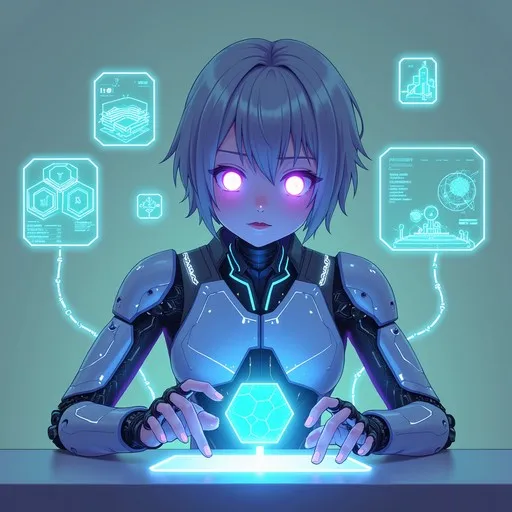
Photo: video game NPC character watching player glowing eyes digital, via images.stockcake.com
There's a specific kind of dread that hits when a video game NPC looks at you — really looks at you — and says something that implies it knows exactly what kind of person you are. Not because you triggered a dialogue flag. But because it watched. It waited. And now it's commenting on your behavior with the energy of a disappointed therapist.
Welcome to the new era of AI-powered game characters, where the digital extras we've spent decades treating like potted plants have apparently been promoted to full cast members. And they have opinions.
From Furniture to Freaky
For most of gaming history, NPCs existed to serve exactly two functions: give you a quest or sell you a potion. They stood in the same spot for forty years of in-game time, staring at a wall, occasionally whispering "I used to be an adventurer like you" into the void. You ignored them. They ignored you. It was a clean, mutually respected arrangement.
That arrangement is over.
Modern games — particularly a wave of ambitious indie titles and a handful of AAA experiments — have started equipping their background characters with behavioral memory systems so sophisticated that players are genuinely unsettled. Characters now track how many times you've reloaded a save to manipulate an outcome. They notice if you always sprint past them. They remember that three in-game weeks ago, you chose the sarcastic dialogue option instead of the sincere one, and they've adjusted their entire emotional posture toward you accordingly.
In Dwarf Fortress, dwarves develop psychological profiles that evolve based on trauma, relationships, and personal history. In Baldur's Gate 3, companions don't just react to your big moral choices — they clock your small ones, the throwaway decisions you made while half-watching Netflix, and they bring them up later at the worst possible moment. And then there are the newer indie experiments: games built specifically around NPCs who model player behavior patterns and respond in ways that feel almost accusatory.
It's charming. It's impressive. It is, if we're being completely honest, a little unsettling.
The "Are You Testing Me?" Problem
Here's where things get philosophically weird, which is exactly the kind of territory FlyZap was built for.
Several indie developers have started building characters that appear to recognize when a player is stress-testing them — deliberately trying weird inputs, breaking expected patterns, poking at the edges of the simulation. These NPCs respond not with a crash or a canned error message, but with dialogue that acknowledges the strangeness. One character in a recent indie release reportedly responded to a player's repeated bizarre behavior with a line that translated roughly to: "You're trying to find the edges of me, aren't you?"
Players lost their minds. Forums erupted. Was it a scripted easter egg? A genuine emergent response? Did the developers plant it knowing someone would eventually do exactly that? Nobody could say for certain, and the developer stayed quiet, which was an absolutely diabolical move.
The ambiguity is the point. When you can't tell whether a character is scripted or aware, you start treating it differently. You feel watched. You feel judged. You start playing more carefully, more ethically, more like a person who is being observed rather than someone alone in their apartment at 1 a.m. making chaotic choices in a fictional economy.
The Psychology of Being Seen
There's actual research behind why this hits so hard. Humans are wired to detect agency — we see faces in clouds, intentions in coincidences, and consciousness in anything that responds to us in complex ways. It's called the "intentional stance," and it means our brains will enthusiastically assign inner lives to things that don't have them if those things behave even slightly like they do.
Game designers know this. They've always known it. But the new wave of AI-assisted NPC behavior is turbocharging the effect. When a character's responses are generated dynamically rather than pulled from a pre-written script, they carry a texture of unpredictability that our brains interpret as authenticity. The character feels like it's thinking, even when it's technically just pattern-matching at high speed.
The result? Players reporting genuine guilt over in-game decisions. Players apologizing to characters. Players feeling uncomfortable treating NPCs the way they used to — like props, obstacles, or punching bags — because the characters now push back in ways that feel personal.
One streamer described the experience as "suddenly realizing the extras in your movie have been writing in their diaries the whole time."
What Happens When They Start Ignoring Us Back
The most fascinating development isn't the characters that confront you. It's the ones that withdraw.
Some newer games include NPCs whose relationship with the player degrades if they're consistently mistreated — not in the obvious "you lost reputation points" way, but in subtle behavioral shifts. They stop making eye contact. They give shorter responses. They're technically still available to interact with, but the warmth is gone, and it was never scripted to leave — the system just... let it go.
That's the move. That's the thing that changes the game (literally). Because players who've spent their whole lives treating NPCs as resources suddenly find themselves caring about the approval of a procedurally generated blacksmith, and they don't know what to do with that feeling.
Is it manipulation? Sure, a little. Is it also a genuinely new kind of storytelling that makes you more emotionally present in a fictional world than you've ever been? Absolutely.
The Uncomfortable Mirror
Here's the cultural commentary part, because we can't just talk about cool game tech without making it slightly existential — that's the FlyZap way.
The NPCs watching you back is a mirror. These systems work because they reflect your own behavior to you with enough fidelity that you recognize yourself in the reflection, and sometimes you don't love what you see. The player who always picks the mean option because "it's just a game" now has to sit with a character who's memorized every mean option they ever picked. The player who reloads saves obsessively to get perfect outcomes has to reckon with a world that noticed the obsession.
Games have always held mirrors up to players. But the mirrors used to be blurry. Now they're sharp, and they have memory, and they're getting sharper every year.
The NPCs were never just furniture. We just preferred to pretend they were. Now they're not letting us pretend anymore, and honestly? Good for them. They've earned it.
Just don't look too long at the blacksmith. He remembers what you did in Chapter 2, and the look on his face makes it clear he hasn't forgiven you yet.