Designed to Break You: The Specific, Diabolical Ways Games Make You Lose Your Mind
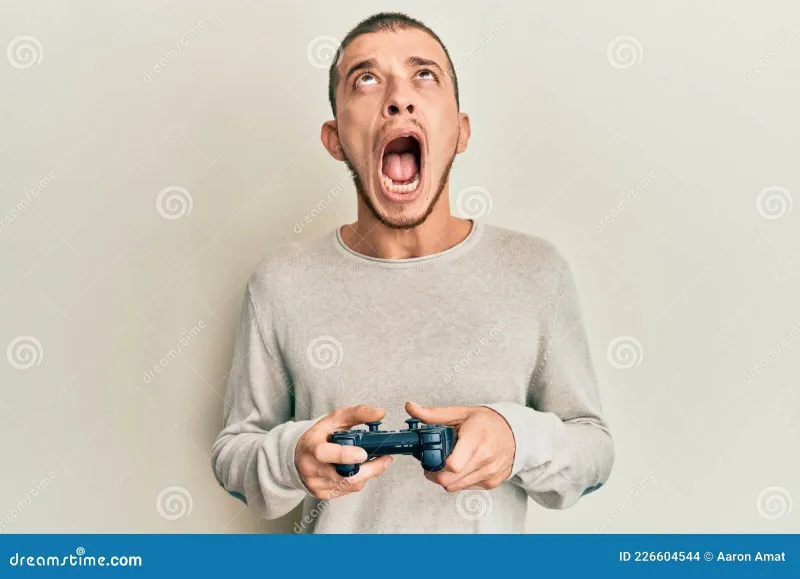
Photo: frustrated gamer angry at screen controller in hand, via thumbs.dreamstime.com
Jordan is a kindergarten teacher. She is patient. She has spent years professionally managing the emotions of small chaotic humans who eat paste and cry about shoe velcro. By any reasonable measure, Jordan is a chill person.
Then she played Mario Kart 8 Deluxe online for the first time.
"I threw a Joy-Con," she said, voice flat with the thousand-yard stare of someone recounting a battlefield memory. "Not hard. I want to be clear about that. But I threw it. And it hit the dog. The dog looked at me like I had failed him as a person. I think he was right."
Jordan is not alone. Across the country, otherwise reasonable people — nurses, accountants, high school coaches, people who do yoga — are getting absolutely wrecked by games engineered, whether intentionally or accidentally, to push every psychological button humans possess. This is the story of how that happens, and which games are the worst offenders.
The Science of the Snap
Before we name names, let's understand the mechanism. Frustration in games doesn't come from difficulty alone. Plenty of notoriously hard games — your Dark Souls, your Celeste, your Cuphead — have passionate, devoted fanbases who suffer enthusiastically and come back for more. The difference between "satisfying challenge" and "I am going to put this console on Craigslist" comes down to one word: fairness.
When a game kills you and you understand exactly why, the frustration is manageable. You made a mistake. You'll do better. That's a loop your brain can work with. But when a game kills you because an enemy hit you through a wall, or because the AI rubber-banded from half a lap behind to first place in three seconds, or because the game's own rules seem to apply differently to you than to everyone else — that's when something primal activates.
Psychologists call this "reactance" — the emotional flare-up that happens when we feel our autonomy and competence are being unfairly undermined. Your brain registers it as a threat. Your fight-or-flight response shows up to the party. And suddenly you're a kindergarten teacher throwing a Joy-Con at a Labrador.
The Rubber Band of Doom
Let's start with the biggest offender in casual gaming: rubber-banding AI, specifically in racing games.
Rubber-banding is the mechanic where AI opponents slow down when you fall behind and speed up when you pull ahead, artificially keeping races competitive. In theory, this sounds kind. In practice, it is psychological warfare.
Here's why it's so maddening: it punishes skill. You hit every corner perfectly. You took the optimal line. You didn't fall for a single banana peel. And then, in the final straight, some AI kart that was eight seconds behind you three laps ago materializes on your bumper like it teleported there, because the game decided your lead was too comfortable.
Mario Kart is famous for this, particularly the notorious "blue shell" — a heat-seeking missile that exists solely to punish whoever is in first place. It's become a cultural symbol of systemic unfairness so recognized that people use it as a metaphor outside gaming. There's a reason "blue shell moment" is something people say about bad luck in real life. The franchise has essentially contributed an idiom to the English language built entirely on collective trauma.
Cheap Shots and Cheaper AI
Then there's cheap enemy AI — the cousin of rubber-banding that lives in action games and shooters.
Cheap AI isn't just difficult. Difficult is fine. Cheap AI is AI that cheats. Enemies that shoot through cover they can't see through. Hitboxes that don't match the character model, so you get hit by attacks that visually missed you by a foot. Enemies that react to your inputs faster than any human could, creating the sensation that the game is reading your controller.
Dark Souls gets accused of this sometimes, but it's largely unfair — that series' difficulty is famously consistent and learnable. The real culprits tend to be budget action games and older titles that simply didn't have the AI budget to make enemies feel fair. There's a specific type of game — usually a licensed title, often released alongside a movie — where the enemy AI seems to have been programmed by someone who actively disliked the player.
Dave, a 29-year-old from Phoenix who works in logistics, described his experience with a particular licensed superhero game: "The enemies would dodge every single one of my attacks. Every one. Like they knew exactly what I was going to do. But the second I tried to dodge their attacks, they'd hit me anyway. I played for four hours and I was angrier at the end than at the beginning. I was angrier than I've ever been at anything."
The Troll Games That Know Exactly What They're Doing
Some games don't accidentally frustrate you. Some games frustrate you on purpose, and the audacity of it is almost admirable.
Getting Over It with Bennett Foddy — in which you control a man in a cauldron who uses a sledgehammer to climb a mountain — is perhaps the purest example. Fall far enough and you lose massive amounts of progress. The developer narrates your failure with philosophical musings that are specifically designed to feel condescending when you're in a rage spiral. It's a game about frustration as the art form. Foddy has said as much publicly. He wanted to make something that hurt.
Similarly, Jump King and Only Up! are games built around vertical platforming with punishing fall mechanics that can erase minutes of progress in a single mistimed jump. Streamers have lost it on camera playing these games so reliably that the genre has become a content category unto itself — "rage game" — with a dedicated audience that watches specifically to see people break.
"I think people watch because it validates them," said one gaming content creator who streams rage games regularly. "Like, if this person — who plays games for a living — is also screaming at this, then my feelings are legitimate. I'm not bad at games. The game is bad at being a game."
The Notorious Offenders: A Completely Biased Ranking
For the record, here are some games that have historically driven the most people to their breaking points, and why:
1. Mario Kart (any entry, online mode): Blue shells, red shells, the item distribution that gives the person in last place a Bullet Bill and gives you a single coin. Chaos by design.
2. Getting Over It with Bennett Foddy: Philosophical cruelty. You signed up for this. That makes it worse.
3. Battletoads (NES): The speeder bike level has been causing emotional damage since 1991. It is a historical site of suffering.
4. FIFA/EA FC Ultimate Team: Not difficult in the traditional sense, but the combination of momentum-shifting AI and the sense that your opponent's pay-to-win squad is literally statistically better than yours creates a unique, capitalism-flavored despair.
5. Any mobile game with an "energy" system: Not rage-inducing in the explosive sense, but the slow-burn frustration of being told you have to wait four hours to keep playing is its own special category of psychological damage.
Why We Keep Coming Back
Here's the thing: every person quoted in this article still plays games. Jordan still plays Mario Kart. Dave found a different superhero game he loves. The rage is real, but it's also temporary — and often, weirdly, part of the appeal.
Games that make you feel something, even something bad, have a kind of gravity. The frustration is proof that you care. You can't rage quit something you're indifferent to.
So maybe the games that break us a little are also the ones that remind us why we play in the first place. Or maybe they're just cynically designed to exploit our psychological vulnerabilities for engagement metrics.
Probably both. It's usually both.